Last month, more than 10,000 Air Canada flight attendants walked off the job. They demanded higher wages and pay for all the hours they work.1 The strike only lasted 3 days before management caved.2 “Unpaid work is over,” the Air Canada Component of the Canadian Union of Public Employees (CUPE) announced.3 The class historian Will Jones took to Bluesky to quip, “direct action gets the goods.”4
Pompey conquered Sicily for the Romans more than 2000 years ago.5 The defeated soldiers at Messana told him he was forbidden from conquering the city by an ancient law of the Romans. The general responded, “don’t quote the law to those with swords.”6
The law is only as strong as the government wielding the sword, sickle, or hammer. Canadian courts called the flight attendants’ strike illegal. They struck Air Canada anyway. The airline was forced to cancel flights. The union defied two back-to-work orders. The costs mounted. The strike disrupted half a million travelers that weekend, but the members remained steadfast in the face of large fines and possible jail time.7
CUPE’s national president Mark Hancock laid the blame for the strike squarely at the feet of Air Canada:
“We are here because of Air Canada, a company that clocked $3.5 billion in profit in the past few years. And a company that thinks simply paying workers for their time on the job is too much to ask.”8
A union statement explained the need for the strike in more detail:
Air Canada flight attendants are not paid for a significant portion of their time on the job, including while they perform critical safety checks, attend to onboard medical and safety emergencies, and assist passengers with boarding and deplaning.9
They are only paid for a fraction of their work hours, their time in the air. One reporter asked Hancock, “What are you willing to do” to change this? “Be fined, go to jail?”10
“We’ll do whatever it takes,” Hancock answered. Backed by 99.7% of the flight attendants, Hancock was even willing to go to jail himself.11 But that wouldn’t put planes back in the sky.
Air Canada took this solidarity very seriously. Good help is hard to find in this economy. Air Canada knew it couldn’t replace 10,000 employees. No employer can these days. Jailing 10,000 flight attendants would keep those planes grounded indefinitely. Management caved because the sword cut both ways.

This is why companies prefer the grievance and arbitration process to work stoppages. Say management at BIW unjustly suspends an electrician (E02) for 5 days. The union files a grievance, and the E02 wins backpay. The total cost for the company is 40 hours of compensation for that E02 plus the cost of hearing the grievance. Suppose the company paid 5 people to attend a 1-hour grievance hearing at more-or-less the same rate of pay as the E02. Thus, total damages are 45 hours. At Grade 10, this grievance cost the company a little more than $1,400 ($32.45 × 45 = $1,460.25).
Compare $1,400 to the cost of a strike. Say that E02 came from a 20-person cable-pulling crew. They decide to stop pulling cable until he returns to work. They go out on strike for 5 days. Now, the total cost to the company is 800 hours (40 × 20 = 800). Even if the crew is compensated at a Grade 5 average, this 5-day strike costs the company over $22,000 ($27.83 × 800 = $22,264). Of course, the company isn’t shelling out $22,000 in backpay at the end of the strike. But the only reason they can pay the crew more than $22,000 a week is because they take in more than that from the Navy. No cable pulling, no profit.
If strikes are a sword, then grievances are a butter knife. You can see why BIW forced the union to accept a “no strike” clause after brutal back-to-back strikes and a lockout in 1985.12 Nowadays, Article 25 prohibits the union from calling a strike during the term of the contract.13 Strikes cut too deep!
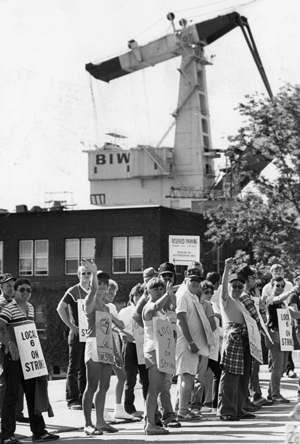
Article 25 be damned, what if every member of Local S6 walked out tomorrow anyway? If BIW could replace all 4,000 of us with subcontractors, they would have done it in 2020. We won that strike. The trick was getting everyone to stick together.14
The 10,000 flight attendants who struck Air Canada show us what’s possible when we stick together. It didn’t matter that the law said they could go to jail. Direct action gets the goods, not laws, grievances, or arbitrations. Air Canada couldn’t replace 10,000 employees. There aren’t 4,000 people beating down the gate to work at BIW.
We have a lot of leverage, but no grievance should have to end in a strike. Strikes should always be a last resort, especially illegal ones. It is in everyone’s best interests to avoid adversarial labor relations boiling over. Tomorrow, flight attendants will vote on the tentative deal they reached with Air Canada to end the strike. Some are upset about the way their union was forced to make a deal “under quite a bit of duress.” “We had the threats of jail time for our leaders. We had threats of fines for the union. It shouldn’t have to come to that,” one flight attendant told Al Jazeera.15 Regardless of the outcome, the way the government responded to the flight attendants strike will promote adversarial labor relations at Air Canada for a long, long time. This is unfortunate for everyone who works there.
- George Wright et al, “Air Canada delays return to flights after union defies government order,” BBC, August 17, 2025, accessed August 20, 2025. ↩︎
- Ian Austen, “After Defying Back-to-Work Orders, Air Canada Employees Reach Tentative Deal,” The New York Times, August 19, 2025. ↩︎
- CUPE, “CUPE, Air Canada reach a tentative agreement,” news release, August 19, 2025. ↩︎
- Will Jones (@willjones.bluesky.social), “Direct action gets the goods,” BlueSky, August 19, 2025. ↩︎
- Eric William Gray, “Pompey the Great: Roman statesman,” Encyclopedia Britannica, May 16, 2025, accessed August 20, 2025. ↩︎
- Paraphrased from Plutarch, The Life of Pompey, translated by Bernadotte Perrin (1917), 10.2. ↩︎
- Ian Austen, “After Defying Back-to-Work Orders, Air Canada Employees Reach Tentative Deal,” The New York Times, August 19, 2025. ↩︎
- CTV News, “CUPE national president says union ‘will do whatever it takes’ for Air Canada’s flight attendants,” YouTube, August 18, 2025, 1:24. ↩︎
- CUPE, “Air Canada flight attendants vote to strike if necessary to end unpaid work and poverty wages,” news release, August 5, 2025. ↩︎
- CTV News, “CUPE national president says union ‘will do whatever it takes’ for Air Canada’s flight attendants,” YouTube, August 18, 2025, 2:28. ↩︎
- Ibid; CUPE, “Air Canada flight attendants vote to strike if necessary to end unpaid work and poverty wages,” news release, August 5, 2025. ↩︎
- “Bath Iron Works Shut Down In Face of Impending Strike,” New York Times, June 29, 1985; Peter Perl, “Maine Shipyard Is Idle,” The Washington Post, July 16, 1985; Agreement between Bath Iron Works Corporation and Industrial Union of Marine and Shipbuilding Workers of America, AFL-CIO, and Its Local No. 6: October 8, 1985 to August 14, 1988 (Bath Iron Works, 1985), 43. ↩︎
- Agreement between Bath Iron Works and Local S6: August 21, 2023 to August 23, 2026 (Bath Iron Works, 2023), 50. ↩︎
- Kathleen O’Brien, “BIW union accepts contract, ending 9-week strike,” Portland Press Herald, August 23, 2020. ↩︎
- David Ball, “Air Canada flight attendants hold controversial wage vote,” Al Jazeera, September 4, 2025. ↩︎
 From The Deckplates