Gravelwood Farm Grow Store is a gardening center in Blue Hill specializing in marijuana growing supplies.1 IAM District Lodge 4 has been more active this year organizing Maine’s cannabis industry.2 In May, nine Gravelwood workers voted unanimously to ratify their first IAM contract:
The new Gravelwood union contract includes cost of living adjustments, a 401k retirement plan, paid holidays and 40 hours of paid leave. As a business with less than ten full-time workers, employees at the company are exempt from Maine’s new earned paid leave law, but the new contract allows them to take advantage of this benefit.3
Store-owner Dan Brown voluntarily recognized the union. Brown said:
As a small business owner, I am very proud that our employees were able to organize and join a union to have a stronger collective voice in the workplace. It gives them additional opportunities like a 401k and insurances that are not normally available to other workers in this industry. We are the first grow/feed store that I am aware of to have a union sticker on the business’ window. We hope this new contract helps raise the bar for the rest of the industry to follow and provides an example for other workers and small businesses to follow.4
Brown reacted to his employees’ union drive very differently than big businesses do. This is one reason why small businesses like Gravelwood are the most trusted institutions in America. According to the Pew Research Center, more Americans have a positive view of small businesses than any other institution surveyed, including the military.
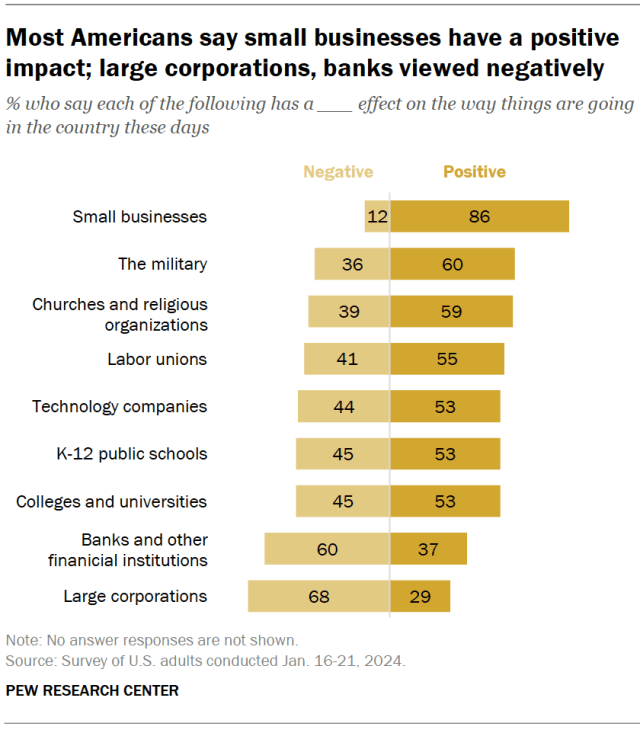
The survey also reveals a shift in how Americans think about unions. While labor unions ranked fourth, large corporations came in ninth.5 Until recently, Americans saw “big labor” through the same lens as big business. According to a new Economics Policy Institute report:
Between 1964 and 2012, Americans’ sentiments toward labor unions and big business moved together, surging and dipping in tandem… In 2016, Americans’ sentiments toward labor and business split. Feelings toward big business stayed flat while feelings toward labor unions warmed to nearly a record high. In 2020, warmth toward labor unions kept climbing to a record high while sentiment toward big business fell to a record low.6
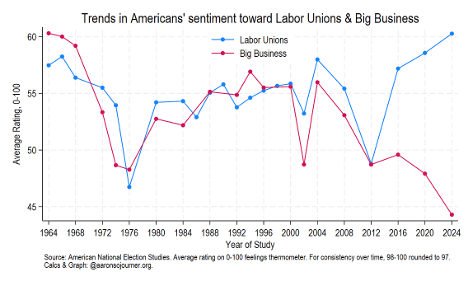
This shift in public opinion was more pronounced in Maine than elsewhere in the country.7 Now is a great time for Maine businesses to work with unions rather than against them. Together, small business owners and union members can form powerful coalitions Americans can trust.
One obvious benefit these partnerships can provide small businesses is political. Small business owners like Brown do not have the same resources big businesses can dedicate to lobbying. The same goes for individual fishermen. The Maine Lobstering Union, IAM Local 207, “formed to give fishermen a unified voice at the state and federal level.”8 With support from the IAM, Local 207 members have delivered testimony from Augusta to Washington, D.C.9 Like the lobstermen, small businesses can rely on their employees to lobby for them. Unions can give them the resources to do so effectively.
Studies show that union workers are more politically active than non-union workers. According to the Center for American Progress:
Unions help decrease the costs and increase the benefits of participation so that more people get involved [in politics]. They do this in a number of ways—from simply knocking on doors and letting people know about an election and providing information about an issue to helping people get to the polls or write a letter and making people feel more powerful and thus likely to succeed. Relatively few people participate spontaneously in politics but rather are likely to take action when groups such as unions mobilize them to do so.10
The IAM mobilized cannabis workers last year. Their lobbying has already had a profound effect on the industry. In April 2024, a Local S6 newsletter shared:
The IAM partnered Maine Cannabis Union [MCU] recently had a big win with the passing of LD 2147 through the Maine House of Representatives. The bill would exempt certain cannabis infused edibles, like gummies and chips, from the requirement of marking each individual edible with a symbol signifying that it contains THC. The MCU has identified this requirement as impractical and burdensome. Additionally, products manufactured before the requirement without the marking would be prohibited from sale, forcing small business owners to bear thousands of dollars in losses.11
Maine’s cannabis industry operates in an uncertain and ever-changing legal environment. Owners like Brown have to pay attention to what’s happening in Augusta. When he opened Gravelwood, it had just become legal for Mainers to grow their own marijuana. “We’ve been in the medical marijuana field for the past four years and that’s the niche that isn’t being met,” Brown said. “Because I’ve been doing this for four years, I saw the holes. There are certain products that growers would run out of and only a few stores that carry them.”12 Now, he sees the potential in a unionized cannabis industry.
A week’s vacation is a small price to pay for plugging the holes in our damaged economy. It’s no secret Maine’s economy isn’t working for working Mainers. I hope Brown sees a significant return on this contract’s investment in his community. There is no shortage of holes to plug, so I hope other small businesses will follow Brown’s example.
- Jennifer Osborn, “Marijuana growing supply shop opening in Blue Hill,” The Ellsworth American, February 21, 2017. ↩︎
- General Membership Meeting Minutes, April 12, 2025, IAM Local S6. ↩︎
- Andy O’Brien, “Blue Hill Grow Store Workers Win First Union Contract,” Maine AFL-CIO, May 27, 2025; ↩︎
- Quoted in Andy O’Brien, “Blue Hill Grow Store Workers Win First Union Contract,” Maine AFL-CIO, May 27, 2025. ↩︎
- “From Businesses and Banks to Colleges and Churches: Americans’ Views of U.S. Institutions,” Pew Research Center, February 1, 2024. ↩︎
- Aaron Sojourner & Adam Reich, “Americans favor labor unions over big business now more than ever,” Economic Policy Institute, May 20, 2025. ↩︎
- Ibid. ↩︎
- “About Us,” Maine Lobstering Union Local 207, accessed June 3, 2025. ↩︎
- For an example of Local 207 testifying in Washington, see IAM, “Maine Lobstering Union Testifies Before U.S. Congress on Protecting Maine’s Safe and Sustainable Lobster Fishery,” news release, April 19, 2023. ↩︎
- David Madland & Nick Bunker, “Unions Make Democracy Work for the Middle Class: Organized Labor Helps Ordinary Citizens Participate More and Have a Greater Say,” Center for American Progress Action Fund, January 5, 2012. ↩︎
- Local S6 newsletter to members, April 12, 2024. ↩︎
- Quoted in Jennifer Osborn, “Marijuana growing supply shop opening in Blue Hill,” The Ellsworth American, February 21, 2017. ↩︎
 From The Deckplates