When this post goes up, I will be in downtown Bath watching fireworks commemorate America’s 249th birthday. A lot has changed since our country won its independence all those years ago. Our Founding Fathers realized that no country can survive so long without changing.
They wouldn’t have recognized the industrialized nation FDR1 inherited in 1935. When he signed the National Labor Relations Act (NLRA) the day after America’s 159th birthday, it was the height of the Great Depression. Robber barons were looting the nation while working people starved. Many recalled Thomas Jefferson’s call to action. “The tree of liberty must be refreshed from time to time with the blood of patriots and tyrants.”2 FDR had to save capitalism from itself, and that meant adapting to new political realities. The country would have to change once again. Although FDR’s vision for a second bill of economic rights never came to pass, the NLRA has stood the test of time.
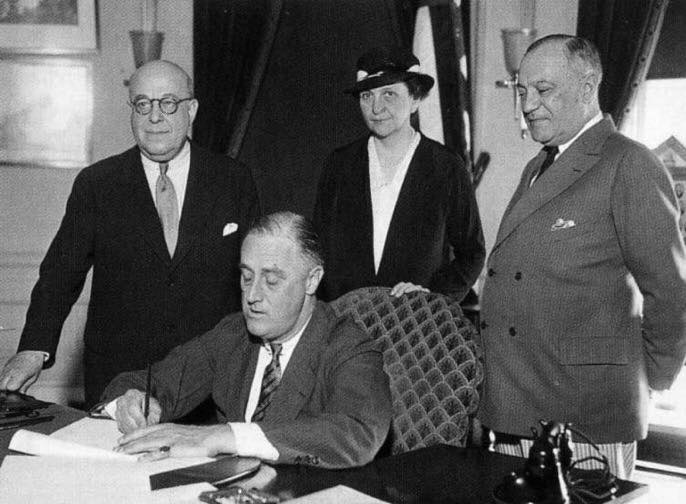
The NLRA will turn 90 years old tomorrow. Since 1935, the NLRA has given workers the legal right to form unions and collectively bargain for a better life.3 Workers today cannot imagine organizing without a National Labor Relations Board (NLRB). It may surprise them to learn that the union we would eventually come to know as IAM Local S6 was already a year old when the NLRA became law.
In 1934, IUMSWA4 chartered Local 4 to represent shipbuilders at Bath Iron Works.5 Shipbuilders did not need legal recognition to organize. They often resorted to illegal means to achieve a better life for themselves. There were frequent wildcat strikes and encounters with police. It took 21 years for IUMSWA to win a certification election at BIW. It took another decade for the company to fully recognize the union with an invitation to a launch party.6 Almost sixty years later, the union is an institution at BIW. Nobody can picture a time before the union.

This may be the first time you’re picturing it. That’s for a very simple reason. Workers have always been standing up for themselves, but teaching us how they won is not in the interest of anyone in power. Even the bosses have forgotten that the NLRA meant compromise. We engage in collective bargaining instead of collective action. We file grievances instead of stopping production. These processes are much better for their bottom line.
Donald Trump has found himself in a position to overturn many of the reforms which saved American capitalism from itself. One of his first acts as President was to hobble the NLRB.7 Then, he eliminated collective bargaining rights for federal workers and shredded their contracts.8 For now, the NLRA protects private sector workers from the same fate, but it doesn’t seem far-fetched that Trump will shred it, too.
Mainstream media might call Trump’s attacks on labor “unprecedented.” They are not. What’s unprecedented are the 90 years of labor peace the NLRA has afforded the country. We will be okay, but only as long as we look out for one another and stand up to injustice on the job. Here, we can learn from our history.
I had our history of direct action in mind last year. In November, I led a group of pipefitters to kick in a hull superintendent’s door. We settled an overtime dispute through direct action, not any legal processes backed by the NLRA. More recently, the riggers forced the company to the table to negotiate a specialist model. They did this by refusing to sign up for any overtime until the company signs off on raises. This action is ongoing.
For 90 years, the NLRA has afforded us protections, but it doesn’t matter if tomorrow is its last birthday. Our union existed before the NLRA. It will exist after the NLRA. It will exist as long as shipbuilders are willing to stand up for each other. Occasionally on the picket line, but much more often, on the deckplates.
- President Franklin Delano Roosevelt ↩︎
- “The tree of liberty… (Quotation),” monticello.org, accessed July 2, 2025. ↩︎
- National Archives, “National Labor Relations Act (1935),” accessed July 2, 2025. ↩︎
- Industrial Union of Marine and Shipbuilding Workers of America ↩︎
- David Palmer, Organizing the Shipyards: Union Strategy in Three Northeast Ports, 1933-1945 (Ithica, NY: Cornell University Press), 54. ↩︎
- Charles Scontras, Time-line of Selected Highlights of Maine Labor History: 1636-2015 (Orono, ME: The University of Maine Bureau of Labor Education, 2016), 116. ↩︎
- Andrea Hsu, “Trump fires EEOC and labor board officials, setting up legal fight,” NPR, January 28, 2025; Emily Peck, “Trump fires acting Labor Board chair in legally dubious move,” Axios, January 28, 2025. ↩︎
- White House, “Exclusions from Federal Labor-Management Relations Programs,” news release, March 27, 2025; White House, “Limiting Lame-Duck Collective Bargaining Agreements That Improperly Attempt to Constrain the New President,” news release, January 31, 2025; also see Aurelia Glass, “The Trump Administration Ended Collective Bargaining for 1 Million Federal Workers,” Center for American Progress, May 22, 2025. ↩︎
 From The Deckplates